
SCRIPTURE READING: Rom 11: 16 – 24 and Proverbs 9:1 – 2
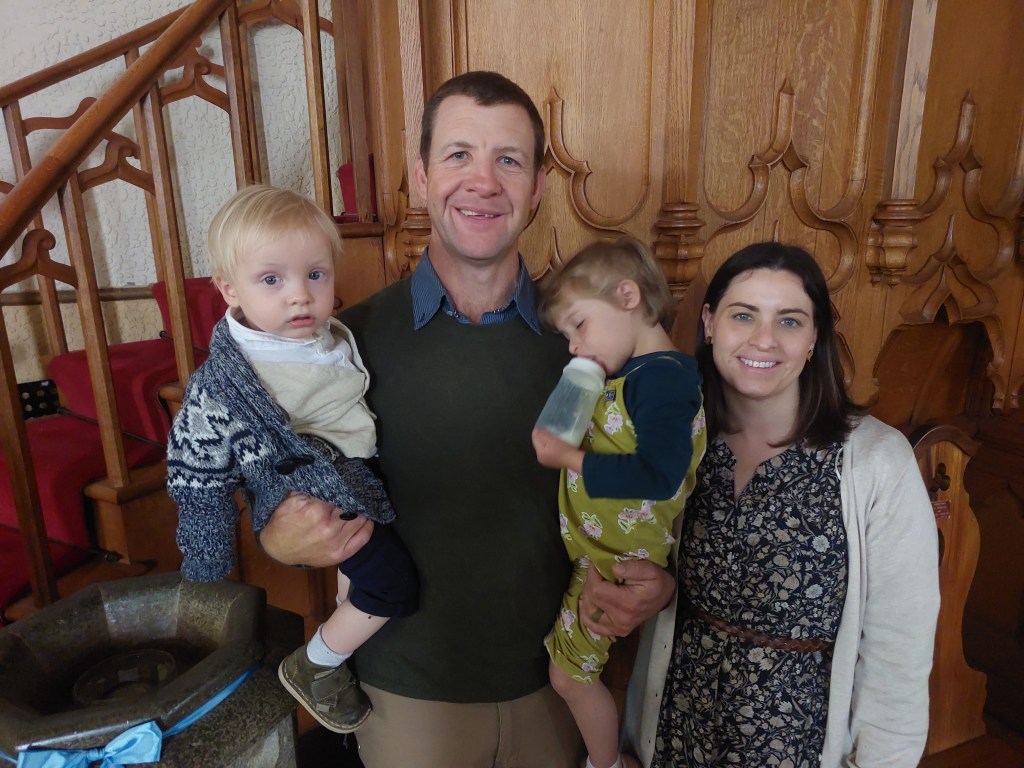
This morning Owen Barend van der Mescht is grafted onto Christ the rootstock.
He becomes part of Christ and all His benefits. It is not the child being baptized who makes the choice, so that one should become haughty about it. It is God who, out of free initiative, chooses Owen to become part of His salvation plan. It is not the branch or the shoot that bears the rootstock. It is the rootstock that bears the shoot.
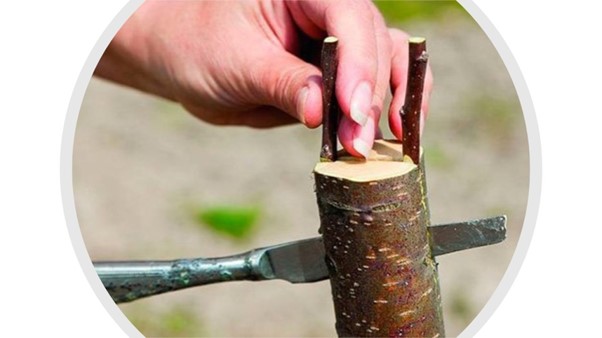
But this inoculated child receiving baptism must live by the goodness of God. As great effort is made with the vaccination process, the parents must take their baptismal vow very seriously. It is a promise before God. I must lead my child to respond in faith to all the promises and commitments of the baptismal covenant.
John Calvin said that the two main elements of religious education should be love and strictness. Love breeds safety and strictness breeds security. With safety and security, a child has everything to enter a successful adult life one day. A young tree must also be constantly pruned to take shape.

If a Karree tree is left untended, it becomes a bush. When a Karree tree is constantly pruned, it becomes a beautiful tree under which you can sit and under which children can play. That is why the Lord also prunes us every day of our lives to become men of God and women of God. That is why a parent must also be prepared to ply the pruning shears, so that one day their children become well-developed young people. That is why disciplining your child is very important, especially in the Book of Proverbs in the Bible.
Psalm 1 speaks of a fruit tree planted by streams of water. The water currents make the fruit tree grow luxuriantly and the tree produces fruit in its time. In the same manner we must raise our children by the streams of water. They must be raised in the church. They must be brought up with Bible stories from the Children’s Bible. They must be brought up with catechesis. The parents must make an effort with their confirmation as members of the Church. They must grow up at Christian camps. You must raise your children in the gates of the Lord’s house. If they see that church attendance is important to their parents, they too will one day be diligent churchgoers and exemplary Christians. If they are raised like saplings by the streams, they too will bear fruit. The pastor Timotheus, for example, received his faith from his grandmother Loïs and his mother Eunice. Therefore, the purpose of baptism is that there should be a transfer of faith. So that the young children are incorporated into the community of faith.
It only takes one generation to raise a pagan. Raise your child without the Lord and you raise a heathen.

Sometimes the storms of life will blow over your tree of life. But if your rootstock is Christ, there will always be a new shoot. You will receive new strength from the Lord every morning. As a rootstock is anchored in the ground, so you must be anchored in Christ Jesus, then you will be able to face the storms of life.
The grafting of your family into Christ the rootstock determines your family’s future.
What is the most important room in a house? What is the most important piece of furniture in the house? Surely the kitchen or dining room is the most important room in the house. The most important piece of furniture in the house is the kitchen table or the dining room table. Of course, I prefer the kitchen table. My first most precious childhood memories were when we had our meals together around a yellow kitchen table every night. I also remember how we used to spend time together at my grandfather and grandmother’s home in Strydenburg, around Grandmother’s kitchen table with the deliciously warm Aga stove nearby. It is burned into my memory.
Gathering around a kitchen table bring married couples, families and larger families together. It creates togetherness and warmth. Relationships grow around the kitchen table.
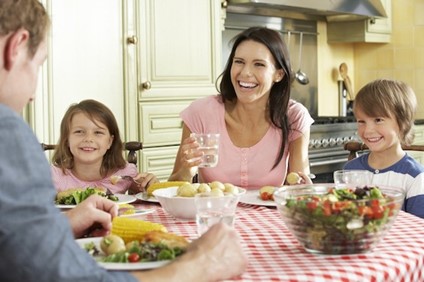
In early biblical times, people usually had only two meals. There was a brunch roughly between 10h00 and 11h00. People ate to gain strength for the day’s work. At the end of the day, the workers went home and had a feast every night. Then they chatted, ate, told stories, danced and drank wine. It was the highlight of every day. It is written in Psalms 23: 5(a), “You set a table for me”.
In Psalms 128:3 it says, “Your wife is like a fruitful vine in the inner rooms of your house. Your children are like olive trees around your table.”
Proverbs 9:1 – 2 reads, “Wisdom built her house, she carved out her seven pillars. She slaughtered her animals, mixed her wine, and also prepared her table.”
In the Passover tradition families ate the Passover meal together every Friday evening. The father of the house told his family each week why they celebrated the Passover. It was to celebrate their exodus from Egypt, the place of slavery.

In the New Testament the Passover was replaced with the Lord’s Supper, which is also a meal taken at a table. The Lord’s Supper binds the congregation in unity, to remember that Jesus Christ redeemed us from the slavery of sin.
The early church also regularly ate together every Sunday, the so-called common meal, to celebrate their inner connectedness to one another. This custom made the Christian church well-disposed in the community and their numbers increased.
You see, if the table tradition dies, then the quality of relationships dies.
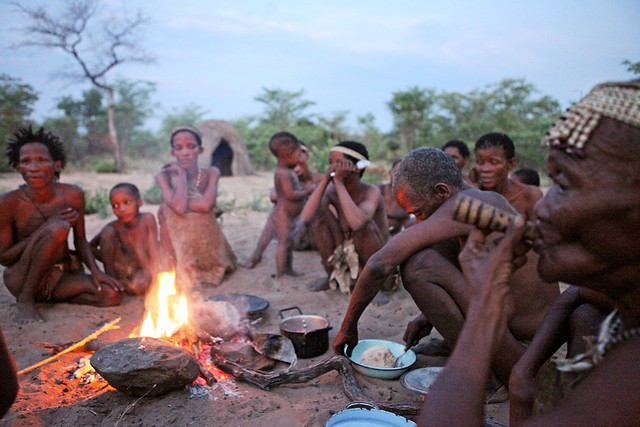
The Bushmen’s “kitchen table” was to sit around the fire every night and tell stories, eat, mingle, tell legends and imitate animal sounds and movements. That is why the Bushman tradition has existed in Southern Africa for thousands of years. But unfortunately, the Bushmen people have westernized. They got televisions, they got cell phones and they got ovens. They no longer get together at Smits drift like their ancestors. The Bushman culture is dying out, because their fires (their kitchen table) no longer exist.
Before 1976, marriages and families were much healthier because there was no television or mobile phones or internet and technology. People were still spending time together talking around the kitchen table.
With the advent of television, people ate on trays in front of the television. With the advent of mobile phones, people are busier around the dinner table sending text messages than talking to each other. So, the kitchen table is neglected.

Time around the kitchen table is sacred time. Those 45 minutes for dinner are sacred. The television program can either wait or be recorded. The mobile phone can easily be switched to silent mode. In those 45 minutes we give each other 100% of our attention. It makes marriages survive; it gives security to children. It creates quality time in relationships. These times become precious memories. Food is not made to be eaten alone. Food should be consumed in company and togetherness.
Prof Anna Fishel of the Harvard Medical School writes in “The Washington Post” as follows, “Kids who eat dinner with their parents experience less stress and have a better relationship with them. This daily mealtime connection is like a seat belt for traveling the potholed road of childhood and adolescence and all its possible risky behaviours.” She also explains that a lot of children’s misbehaviour is due to the fact that there was no kitchen table culture.
Children in particular are brought up around the dinner table. It’s not just about the food, but about the togetherness and relationships that are deepened and strengthened. Grafted on the rootstock and the shoots (children) grow, especially around the family table.
(Rev. Paul Odendaal is pastor of the NG Churches Adelaide and Fort Beaufort.)
 NG Kerke Adelaide en Fort Beaufort